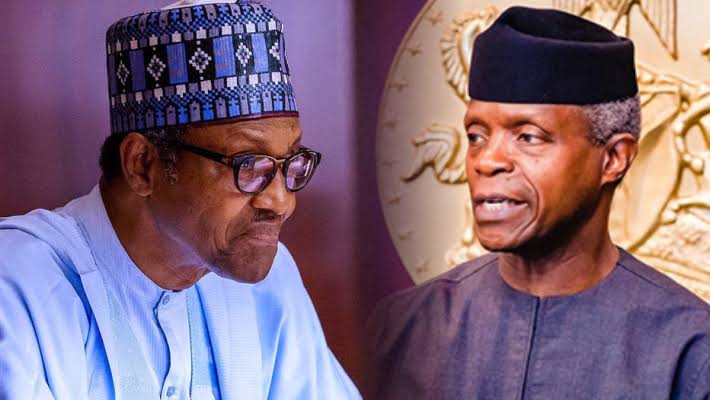
Unless President Muhammadu Buhari signs the fresh amendment to the Electoral Act into law by Sunday, himself, Vice-President Yemi Osinbajo, National Assembly members, governors, their deputies and other statutory delegates in the ruling All Progressives Congress may not be able to vote in the forthcoming primaries.
Others who may be disenfranchised during the primaries, as applicable to all the 17 other political parties, include the National Working Committee members, state party chairmen and secretaries, local government chairmen, their deputies, councillors and party chairmen in the 774 local government areas.
This is as the Independent National Electoral Commission stressed that political parties were expected to submit their delegates’ lists not later than seven days to the primaries.
This implies that since the APC presidential primary starts on Sunday, May 29, if the President does not sign the bill into law by Sunday (tomorrow), the political office holders, including Buhari, may not be able to vote unless they have been voted as delegates.
It also means that if the President does not sign the bill into law by today (Saturday), the political office holders in the opposition Peoples Democratic Party won’t be able to vote unless they are voted as delegates since the party already fixed its presidential primary for May 28 and 29.
Consequently, there is heightened tension in the APC and the PDP over the delay by the President in signing the bill into law.
Some party chieftains, including the Director-General of the Voice of Nigeria, Osita Okechukwu; the majority leader in the House of Representatives, Ado Doguwa; and the Ndudi Elumelu-led minority caucus in the House, said that there could be confusion and crisis if Buhari did not sign the bill promptly.
“Our caucus calls on all Nigerians, the civil society, the international community and all lovers of democracy to prevail on President Buhari to immediately sign the amendment to the Electoral Act, 2022 and save our nation from an avoidable crisis,” Elumelu said in a statement by.
Doguwa also said, “I am aware that the amended clause has been transmitted to Mr President for his assent. I am optimistic that Mr President will assent to it without hesitation whatsoever. It’s an amendment that was well-intended and meant well for the smooth selection of candidates in the various political parties. Any legislation transmitted by the National Assembly to Mr President for assent takes 30 calendar days before counteraction can be contemplated by the parliament. It’s my hope that Mr President will do the needful before it gets out of hand.”
On account of this, the APC also called on INEC to extend the deadline for the primaries, saying the parties were under pressure based on the commission’s “stringent timelines.”
Meanwhile, to reverse what they termed “fundamental error” in the Electoral Act, 2022, the National Assembly hurriedly passed an amendment to Section 84 (8) of the Electoral Act, which states, “A political party that adopts the system of indirect primaries for the choice of its candidate shall clearly outline in its constitution and rule the procedure for the democratic election of delegates to vote at the convention, congress or meeting.”
This implies that if the amendment does not become law, only elected delegates can vote at the convention, thereby disenfranchising thousands of party chieftains.
Having hurriedly passed the amendment into law to make the office holders statutory delegates, with the House of Representatives passing the bill for second and third reading at the same sitting to concur with the Senate, the lawmakers hoped the President would promptly sign it so they and other statutory delegates could vote.
However, as of the time of filing this report, the President, who travelled on Thursday to the United Arab Emirates on a condolence visit and to renew ties with the country, had yet to sign the bill into law. He is expected back in the country today (Saturday).
Having begun handpicking the delegates who will elect the presidential candidate of the APC, governors on the platform of the party are now lobbying Buhari not to sign the recently amended Electoral Act Amendment Bill.
The National Assembly had last week amended Section 84(8) of the Electoral Act to allow statutory delegates to vote at party primaries.
The statutory delegates include the President, Vice-President, serving and former members of the National Assembly; serving and former governors and deputy governors; members of the National Working Committee and state party chairmen and secretaries of political parties.
The President’s delay in signing the amended Act means that as the law stands, only non-statutory delegates will be allowed to vote, except if the APC opts for the direct primary method or outright consensus.
According to the APC guidelines, the statutory delegates are to be elected from each of the 774 local government areas. Each local government is expected to produce three delegates, bringing the number to a total of 2,322 delegates.
However, it was learnt that across the states, no real congress was taking place. Rather, the governors are only drawing up so-called unity lists, while in states that the APC has no governors, the faction loyal to the most senior minister or senator will select the delegates and submit the names to the national leadership of the APC.
A member of the National Assembly, who wished to remain anonymous, said, “The governors will now be fully in charge. Even the President does not have a single delegate. The 2,322 delegates who emerge from the congresses will just be anointed by the governors and they will be the ones to determine the next presidential candidate of the party.
The National Assembly member explained, “As things stand, over 1,000 statutory delegates will not be allowed to vote at the primary, including the 373 members of the National Assembly, who are members of the APC, except Buhari assents the bill. This has given the governors too much power.
“They are now lobbying the President not to sign the Electoral Act, because this is the only way their excesses can be neutralised. Some of Buhari’s ministers, who blame the National Assembly for their failed ambitions, are also pushing the President not to sign it. The only thing that can change the calculation is if the party opts for direct primary.”
The President is currently in the United Arab Emirates and is expected to return today (Saturday).
Attempts to get a response from the Senior Special Assistant to the President on Media and Publicity, Garba Shehu, proved abortive as he neither responded to calls nor a text message on Friday.
However, a Presidency source said Buhari was also angry with the National Assembly for double-crossing him last February.
The President had while signing the Electoral Act in February called on the National Assembly to expunge Section 84(12), which bars all government appointees from taking part in any party primary.
Buhari subsequently sent a request to the National Assembly to that effect. However, the Senate rejected the President’s request, while the House of Representatives did not consider it. Also, after a Federal High Court ruled that the section in question was illegal, the National Assembly appealed the judgment, insisting that ministers, commissioners and aides should not be allowed to contest elective offices unless they first resign.
“The National Assembly double-crossed the President in February. This is why it cannot confidently lobby him for help now. Politics is give and take. Buhari may be magnanimous enough to amend the law now, but the National Assembly has no right to make any demands. Besides, the National Assembly should have amended Section 84(12) as a show of good faith,” a Presidency source stated.